

4-Days Hands-on Drone Technology Bootcamp
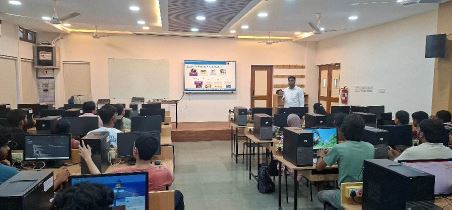
Report: 4-Days Hands-on Drone Technology Bootcamp
Venue: Padre Conceicao College of Engineering (P.C.C.E), Verna, Goa
Organizing Body: Goa State Council for Science & Technology (GSCST) in association with PCCE ACM Student Chapter & Girnaar Factory Business, Pune.
Lead Instructor: Mr. Vikrant, Lead Drone Expert.
Main Coordinators: Mrs. Brenda Fernandes, Member Secretary GSCST, & PCCE ACM Student Chapter Office Bearers.
The four-day intensive, hands-on bootcamp on drone technology was successfully organized from 18th May 2026 to 21st May 2026 at Padre Conceicao College of Engineering. The event aimed to bridge the gap between theoretical aerodynamics and practical Unmanned Aerial Vehicle (UAV) operations. The event was spearheaded by GSCST in association with PCCE ACM Student Chapter and Girnaar Factory Business, Pune. The bootcamp provided students with a comprehensive exposure to drone hardware, flight software, and real-world piloting.
Technical Breakdown
Day 1: Fundamentals of UAVs and Aerodynamics
The bootcamp commenced with an inauguration ceremony, followed by an in-depth theoretical session. Mr. Vikrant introduced the core mechanics of multirotor flight.
●Hardware Anatomy: Detailed breakdown of core components, including Flight Controllers (FC), Electronic Speed Controllers (ESCs), Brushless DC (BLDC) motors, and Power Distribution Boards (PDB).
●Aerodynamic Principles: Explanation of how variations in motor RPM control pitch, roll, yaw, and altitude.
●Power Systems: Deep dive into Lithium Polymer (LiPo) battery compatibility, discussing C-ratings, cell voltage management (nominal 3.7V vs. fully charged 4.2V per cell), and safe discharging practices to prevent thermal runaway.
●Flight Modes: Overview of stabilization protocols, contrasting Manual/Acro mode with sensor-assisted modes like Attitude (ATTI) and GPS-Hold.
Day 2: Software Integration and Hardware Teardown
The second day transitioned into software applications and hands-on mechanical work.
●Software & Data Processing: Introduction to ground control station (GCS) software (such as Mission Planner) and photogrammetry tools used for drone image capturing. Students learned how drones utilize telemetry data to stitch 2D images into 3D topographical models.
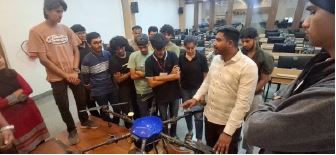
●Hands-on Disassembly: Under strict supervision, students participated in a reverse-engineering exercise. They systematically disassembled a practice drone,
learning to safely disconnect XT60 power leads, unmap UART port connections on the flight controller, and inspect motor mounts.
Day 3: Heavy-Payload Operations and Pre-Flight Protocols
Day 3 shifted focus to industrial applications, specifically agricultural (Agri) drones, followed by simulated flight training.
●Agri-Drone Demonstration: Mr. Vikrant piloted a heavy-lift agricultural drone, explaining the integration of payload distribution and fluid dynamic spray nozzles.
●Pre-Flight Technical Checklist: Students were taught standard operating procedures (SOPs) before arming a drone. This included:
○Checking the K-index for solar storm interference to ensure a stable GPS lock.
○Performing IMU (Inertial Measurement Unit) and compass calibrations.
○Inspecting the leading and trailing edges of propellers for micro-cracks.
○Verifying radio transmitter (Tx) to receiver (Rx) signal latency.
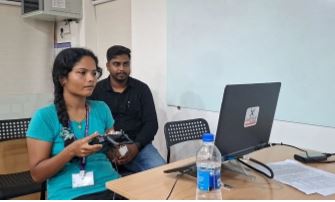
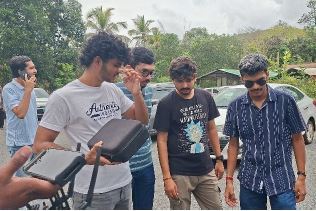
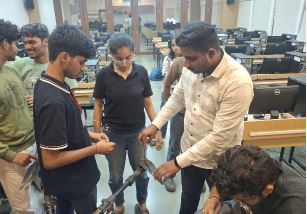
●Virtual Simulation: Students were introduced to physics-based flight simulators using physical RF transmitters. Each student received at least 15 minutes of guided simulator time to build muscle memory for throttle and yaw control without hardware risk.
Day 4: Live Piloting and Valedictory Session
The final day was dedicated to applying the acquired skills in a live environment.
●Simulator Completion: The remaining students completed their mandatory 15-minute virtual flight training.
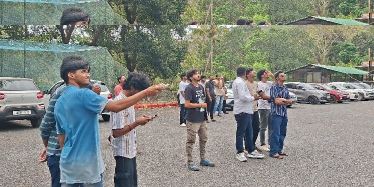
●Live Piloting: Operating under Visual Line of Sight (VLOS) regulations, every student took control of a training drone. Guided by Mr. Vikrant, they executed basic hovering, altitude holds, and box-pattern maneuvers.
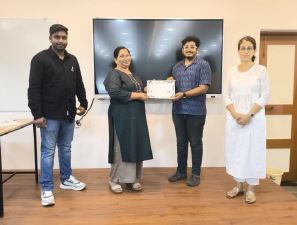
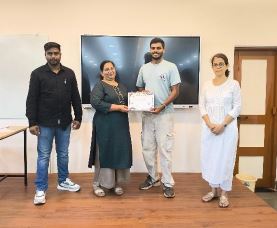
●Closing Ceremony: The bootcamp concluded with a certificate distribution ceremony for all participants. A formal vote of thanks was delivered, expressing gratitude to Mr. Vikrant for his technical expertise.
The four-day bootcamp concluded seamlessly and the student feedback was overwhelmingly positive, with participants specifically highlighting the transition from simulator training to live piloting as a major confidence booster. The event successfully cultivated a strong foundational understanding of UAV technology among the attendees.