


WORKSHOP by Hackathon Winning Team “Introduction to GENAI and LLMs”
1. Overview
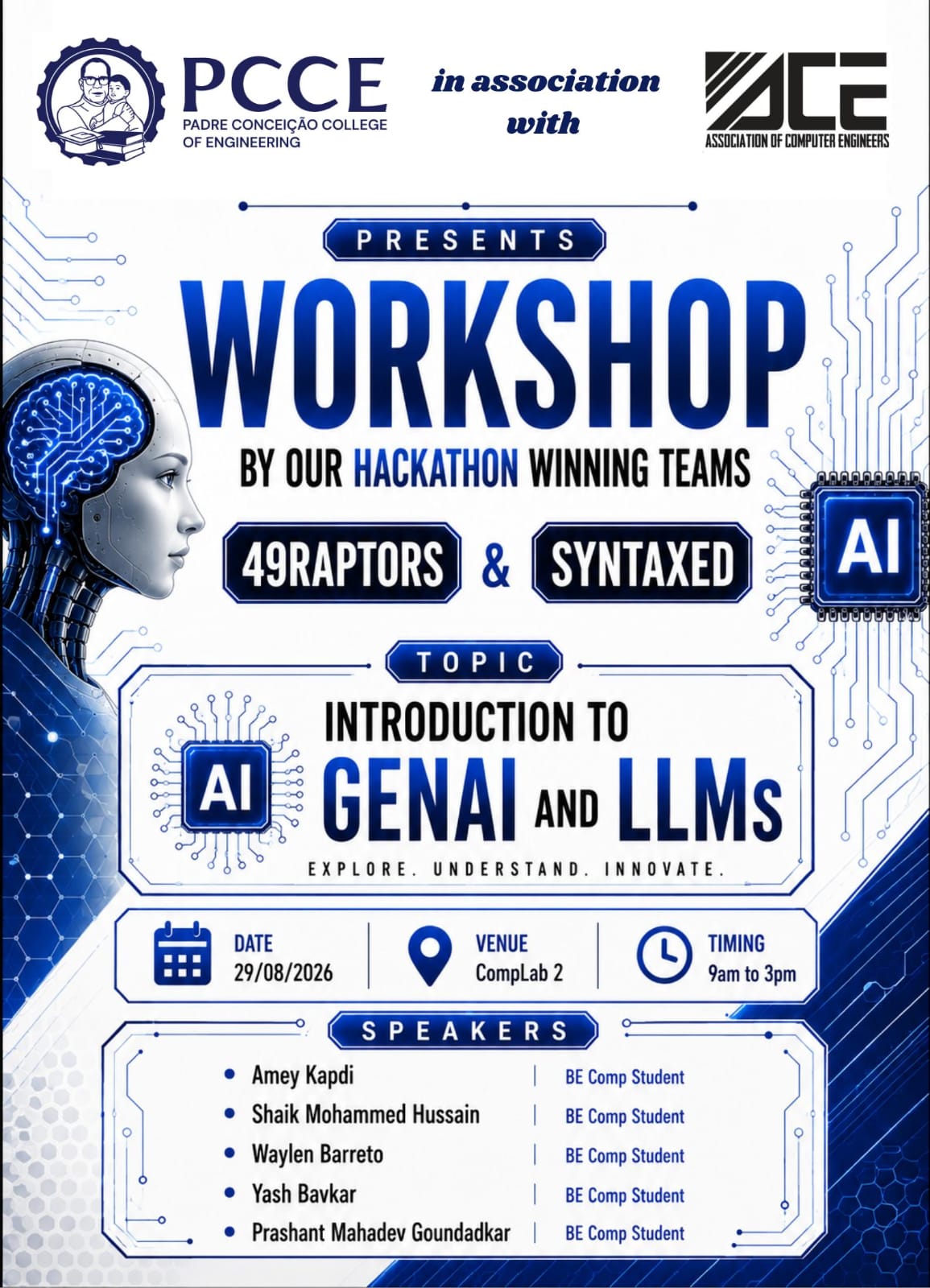
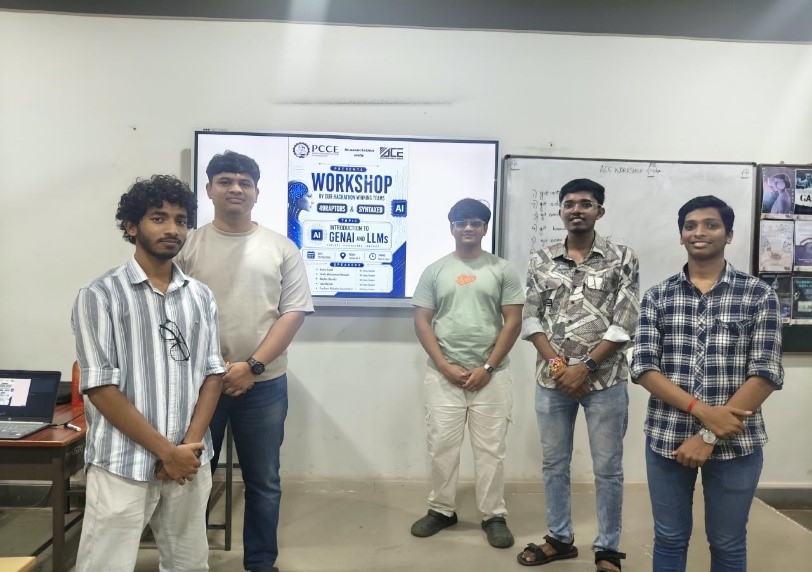
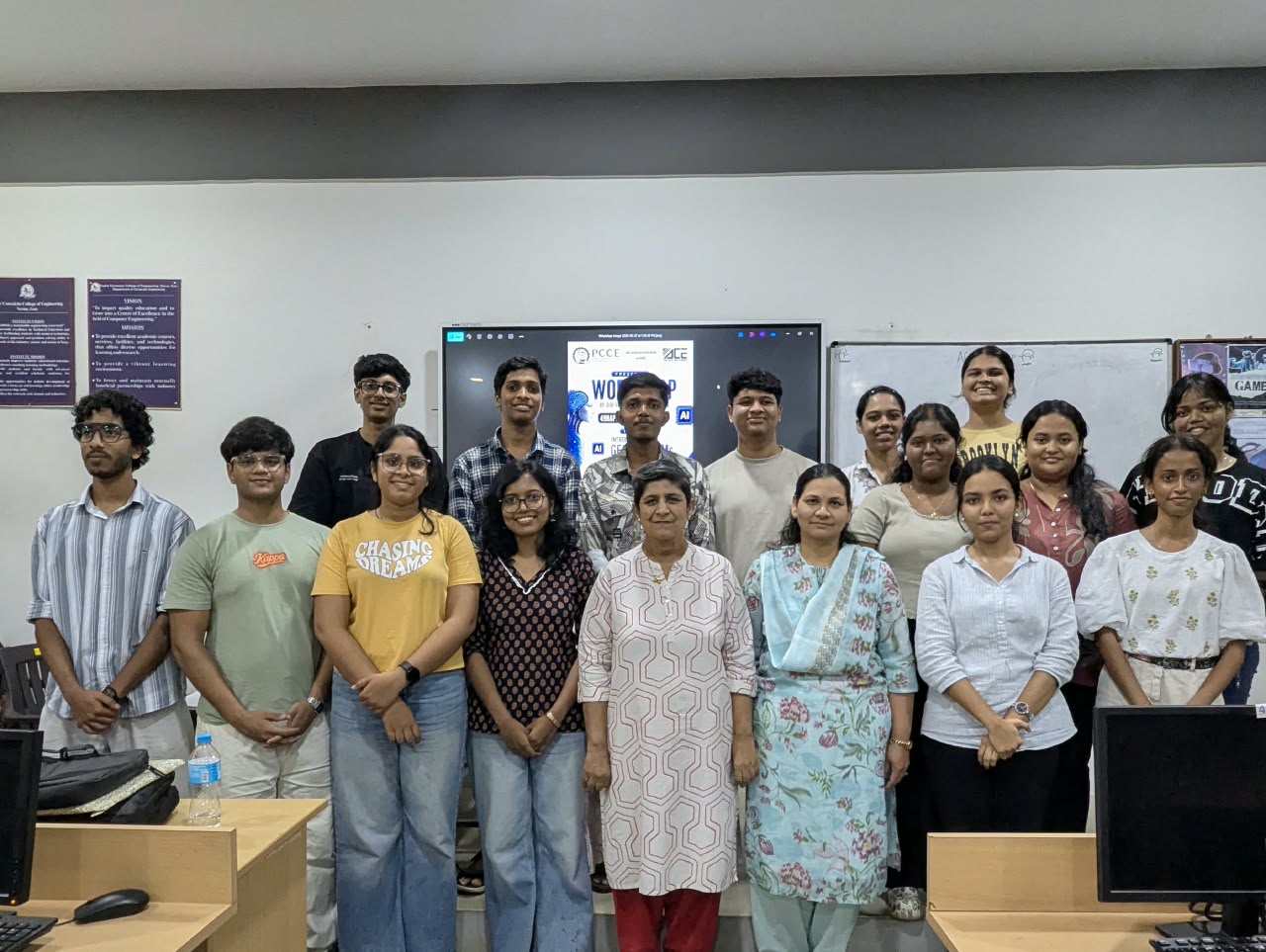
ACE conducted an AI and ML Workshop on 29th August 2026 for the college. The session was conducted by fourth-year students of the Computer Department, who served as speakers for the event. The workshop combined theory sessions on core AI/ML and RAG concepts with hands-on coding activities, followed by a team-building problem-statement competition and a closing fun quiz round with prize distribution to the speakers.
2. Topics Covered
2.1 Introduction to RAG (Retrieval-Augmented Generation)
- RAG gives an LLM access to relevant external data before it generates an answer.
• RAG helps in avoiding hallucination.
2.2 RAG Pipeline
The data preparation stage was covered first: before any retrieval can happen, raw documents are processed into a form the system can search efficiently. This involves:
- Document loading
• Text extraction
• Chunking (an optimization part of RAG)
2.3 Understanding the RAG Vector System
- Text is converted into numbers using transformers.
• Semantic clustering
• High dimensionality
2.4 Vector Embedding and Storing
After embedding, the data is stored in an embedded vector database for fast retrieval.
- Indexing — for optimization
• Metadata — for contextual learning
2.5 Query Processing
The user’s query is converted into a query embedding, which is then checked for similarity against the vector embeddings in the database, using:
- Cosine similarity
• Natural language processing (NLP)
2.6 Retrieval Techniques
- FAISS vector index — used to search a query against embedded data.
• Keyword index (BM25-based).
• Hybrid retrieval, combining vector and keyword search.
• Query router — decides whether to use RAG, Gemini, Google Search, or a combination of these.
2.7 Generative AI and Transformers
- Overview of Generative AI (Gen AI).
• Transformers were explained using ChatGPT as an example — a Generative Pretrained Transformer that predicts the next token after a question is asked.
• Reference to the “Attention Is All You Need” research paper.
• Neural networks and artificial neural networks (ANN).
• Encoder layer, attention mechanism, and decoding layer.
2.8 Agentic AI
- Introduction to Agentic AI.
• Introduction to Multi-Agent AI.
3. Hands-on Activities
Alongside the theory, students worked through hands-on notebooks covering machine learning, RAG-based application building, and agentic AI.
3.1 Machine Learning Hands-on
Students worked on a machine learning notebook using the Student_Performance.csv dataset, covering:
- Loading and preparing the dataset with pandas and NumPy.
• Building a Decision Tree Regressor model.
• Building a Linear Regression model with Polynomial Features to model a nonlinear relationship.
• Evaluating models using metrics such as Mean Squared Error and R² score.
• Feature importance analysis and visualization of results using Matplotlib and Seaborn.
3.2 RAG-based Study Assistant Hands-on
Students built a RAG-based Study Assistant application, covering:
- Installing and using libraries such as google-generativeai, sentence-transformers, faiss-cpu, rank_bm25, pypdf, python-docx, python-pptx, reportlab, and huggingface_hub.
• Extracting text from PDF, DOCX, and PPTX study material.
• Building a Hybrid Retriever combining FAISS (vector search) and BM25 (keyword search).
• Integrating a Gemini-based generation engine to answer questions using retrieved context.
• Building a Study Assistant that could summarize content, generate MCQs, and create flashcards from uploaded material.
• Exporting generated content to PDF.
• Generating educational images to accompany study material.
• Uploading files to build a knowledge base and interacting with it through an interactive chat interface.
3.3 Agentic AI Hands-on
Students worked on an agentic AI notebook, covering:
- Using LangChain with a Gemini model (ChatGoogleGenerativeAI) to invoke an LLM.
• Using DuckDuckGo Search as a tool to fetch live information (e.g., latest stock news).
• Using the Tavily search API as an alternative search tool.
• Defining custom tools such as a search tool and a get-current-time tool.
• Creating an agent with a system prompt, instructing it to act as a stock research assistant that searches for information, uses tools, explains its reasoning, and avoids hallucination.
• Running the agent to analyze stocks (for example, Tata Motors and Vedanta), covering latest news, earnings performance, growth prospects, industry trends, risks, and a final recommendation.
4. Team-Building Competition
At the end of the session, a team-building competition was held. Teams were required to select a problem statement (PS) and build a model to solve it, applying the concepts covered during the workshop.
5. Fun Quiz Round and Prize Distribution
The session concluded with a fun quiz round, followed by a prize distribution ceremony held for the speakers.